December 3, 2009

Evangelion: 2.0 You Can (Not) Advance

Today is the first day Eva 2.0 is (finally!) in theaters in Hong Kong. I couldn't wait any longer and grabbed a ticket to the first show at AMC Festival Walk, our nearest cinema.

It was amazing. Unlike 1.0, the majority of the plot had been redone. The angels looked very different from the original, and the Third Impact happened right after Shinji defeated Zeruel, the fourteenth angel. The most eye-catching feature of 2.0 was probably the introduction of the new character: Mari Illustrious Makinami, with a miniskirt and stockings and eyeglasses. Not everyone likes her, but at least I do. I think the character of Asuka had changed a little from the original. I used to dislike the original Asuka, but this one in 2.0 was much more lovable. Unfortunately, she was quarantined after being infected by Bardiel, the thirteenth angel.

Nonetheless, the indisputable heroine in this movie was Rei Ayanami. It was explicit that Rei was fond of Shinji (and vice versa), and she goes as far as planning a dinner to reunion Shinji with his father, Gendo Ikari. After Rei being eaten up by Zeruel, Shinji yelled "Give Ayanami back to me!" again and again while Unit 1 destroyed the kernel of the angel and Rei was saved by Shinji. In the end, Rei, in the deified form, were hold tightly by Unit 1, now in "a form of being superior than man and close to god".

Right after the ending song, Kaworu Nagisa appeared from the sky and threw a spear (probably the Spear of Longinus) which went right through the body of Unit 1, ending of the movie.

I enjoyed this movie very much. It made possible many of my preferred improvements to the plot of the original TV series, including making Rei a more central role, and the mitigation of Asuka's character. Also, the newly introduced Mari was an attractive girl. By now, I really have no idea where this story is heading to - the Third Impact had happened, what could be next? Anyway, there are two episodes of this epic tetralogy, and it is definitely worth the wait.

Image source: http://www.flickr.com/photos/taishaku/ / CC BY-NC-ND 2.0

November 28, 2009

Convert MP4 to MP3

Have you ever downloaded a music video with DownloadHelper from Youtube.com but don't know how to play it in your portable music player or set it a ringtone of your phone? I've found a small and easy-to-use freeware that can convert MP4 video files to MP3 audio files (more precisely, it converts a wide range of video files to MP3, including MPEG, AVI, MOV, FLV, DVD, VOB). It is simply called Convert MP4 to MP3, which can be downloaded here. Thank My Digital Life for the pointer.

Lyrics Wiki

I'm trying out a new way to collaborate - to invite everyone to edit and correct lyrics. If you are a music lover, you probably find it common to see mistakes in lyrics downloaded from lyrics websites like AZLyrics. Though some websites are nice enough to let you send them messages making corrections to these lyrics; the problem is, 1) it is not handy enough to have to write an email to make a small correction to a lyrics (sometimes just a misspelling), and 2) mostly such corrections are made on-the-go when you are singing along with the lyrics; and after the song, you've probably forgot where and what you have corrected.

I have found a few websites, like Lyriki, that facilitates such collaboration; but most of them does not work very well for this and that reasons. The solution I found is using Google Docs to realize such collaboration. As a demonstration, I've uploaded the lyrics of Eminem's Beautiful to Docs letting everyone on the Internet to view and edit. You may choose to use the viewer mode where you can read and print the document; also, you can follow the link at the end of the page to edit the lyrics even without signing in! You are welcome to make big or small corrections while you sing along. The lyrics is right here.

November 27, 2009

Books Bought

Last week a book fair took place in the Student Residence courtyard, and I bought six items:

  • Adam Smith The Wealth of Nations: I've made attempts to read a copy from the library before, but as it is quite long and comes in two volumes, and it is written in a style of English language not familiar to modern readers, I found it difficult to finish it all at once. Therefore I decided I should purchase a copy of myself.
  • Tim Harford The Undercover Economist: I remember Steven Levitt recommended it and it seems an interesting topic.
  • Bernhard Schlink The Reader: A high school Chinese literature teacher (who turned out to be my aunt) recommended it to me in summer. It is a novel related to World War II, and it has also be shot into a movie (and the heroine is beautiful).
  • Jostein Gaarder Sophie's World: A friend recommended it to me when I was seeking some novels to read. It is about the history of philosophy. It may make an interesting supplement to the Brief History of Western Philosophy I read in high school.
  • Mitch Albom Tuesdays with Morrie: I've seen this book elsewhere quite a lot before. The cover design is simple and fine.
  • Milton Crane (ed.) 50 Greatest Short Stories.

Why Chinese students outperform their Western peers?

A German exchange student is doing a survey on the title topic and asked me about it in two sub-questions: 

1) Describe in your own words how you would revise for an examination. 
2) Do you try to understand what you are learning? (not knowing the dictionary meaning of the word) 

And this is what I replied: 

1. I would say it differs from course to course. For technical courses, I would normally read the lecture notes or textbook or whatever the course has, and summarize the concepts/formulas that are supposed to be remembered by copying them on a sheet of paper or flash cards, and try to memorize. After that I'll re-do the problem sets done before. 

For a non-technical course, I would only do the first part - though this time the work load of the summarization is much more significant. 

I think these methods differ among students. For example, some would sit before a blank sheet of paper and try to recall and jot down the structure of the course with all relevant theorems etc. 

2. I do not fully understand your question. Do you mean whether I will try to understand the material without knowing some words? Well I would say the meaning of a few words really doesn't matter in capturing the essence of a piece of material, except when this word is the concept that the material is trying to explain. However, in the second case, the article will normally pin down a detailed definition of the term, and it dose not matter if you do not know the original/literal meaning of the word - though it helps, it won't be tested anyway. 

That said, personally I would usually look up a new word if it appear in an article I read - be it a textbook or just some novel I find interesting to read - not for getting a better mark though; just that I love enhancing my vocabulary. 

Nonetheless, I think a major contributor to the fact that students educated in China outperform in some areas is that they have much more mathematics in primary and high schools than typical western students. I remember reading an article saying that parents of ethnic Chinese kids in the U.S. always complain that the math taught in school is too easy and superficial; while their Caucasian counterparts complain that the math taught are too difficult for their children to learn. 

For me, I do not find any subject that merit equal importance as math, except for possibly language courses, in pre-tertiary education. It's used everywhere and in every academic discipline.

November 23, 2009

What College is about

Today a Year-1 student approached me asking about minoring in Statistics. He complained that there are too many prerequisite courses and he was not so sure whether he could accomplish it. And here is what I replied:

...There are prerequisites; however, you may consider waiving them by consulting the math department head... [This practice] is common for students pursuing advanced levels of achievement. Do never be impeded by mere stated prerequisites. You will find the experience of taking advanced courses especially rewarding as you will learn a lot along the way and challenge your intellectual limit.


While I was reading Cal Newport's How to Win at College recently, I've been thinking, for what we came here to college? A higher than everyone else's GPA? A presidency of a student club? Being awed by peers and favored by teachers? The last two paragraphs of the above stated book really touched me:

I conclude this book with these words because I believe that pursuing your ambitions for the right reasons is more important than any specific strategy for succeeding at college. If you want to succeed because you like the attention, then this book can't help you. If you want succeed to prove yourself to others, then this book can't help you. If you want to succeed because you enjoy adulation and praise, then this book can't help you. You will never really win, because the fear of failure will always be lurking around the next corner.

If, however, you want to succeed because you love the excitement of pushing your potential and exploring your world and new experiences, if you want to succeed because life is short and why not fill it with as much activity as possible, then you will win. If you approach life with an attitude of never having regrets and always having a hopeful smile on your face, you can find a measure of success in all your endeavors. Don't have no regrets, but have plenty of fun along the way. In the end, that is what it is to really win.

So prove yourself only to yourself. Strive to reach your limit. There is no defined success for everyone. Success is defined for you and for you only by achieving the mightiest things in the world as you can.

November 20, 2009

On Learning English, Again

Ever since my success in the TOEFL test, the frequency of people asking me about how to learn English has risen to a brand-new level. Every time there’s someone asking me, I kept thinking, why can’t everybody do the same if I can do it. And here is what I came up with recently.

(Apparently) most everyone can speak their mother tongue very well – basically because they have no other choice, even if we cannot understand something written in our mother tongue, we still have to crack it, possibly aided by a dictionary or an instructor, but still, we have to understand the words in their own "physical form". There is not an alternative since our mother tongue is the primary choice in comprehension. The usual method we use in learning a second language, i.e. translating it into our first language, does not work!

Therefore I can’t stop thinking why we cannot learn a second language as if it is our first. Imagine you are a Chinese, and is reading a text written by the 20th Century Chinese writer Lu Xun (if you are not Chinese, think about some influential writer who lived some a hundred years ago). It is not uncommon for students to complain that Mr. Zhou’s (i.e. Lu Xun's) dialect is obscure and hard to understand. However, even after checking a reference source and having your teacher explain the background and theme of the essay, you still have to rely on your innate language ability to understand the article.

Okay, now let’s look back at learning a second language. When you are presented with a piece of text in English, and if you have trouble understanding quite a portion of the text either because of your lack of vocabulary or impotence to connect the words into meaningful chunks, you probably would look for a Chinese version of the article to read instead. That is at least common of many of my friends - many from the math department read texts in Chinese only!

My advice here: pretend that you can understand even if you don't! This may sound ridiculous at first but if we investigate further, we will find that it is effective in forcing yourself to decipher the meaning of the text as if it is your first language. This is exactly what I experienced back in high school. In fact I couldn't understand original versions of English novels very well until my senior years in high school. In at the first few trials I did encounter manifold problems following the flow, especially the detailed descriptions. But I did not just throw the book away and turn to a Chinese translation - I stuck with the book and read as if I could understand. And by the end of my high school years, I was capable of the vast majority of modern English articles.

This does not work only with reading - it works equally well with listening and speaking. Take speaking as an example. When you speak in English, imagine yourself as a native speaker. Talk as it you are an American or Briton - it does not matter that at first your accent would sound awkward; you will gradually grab the right way to pronounce and intonate along the way. And do speak with confidence; do make yourself heard clearly. Many language learners speak as if murmuring and the listener is simply disappointed because they can't quite hear the speaker.

These are I what I've thought of recently. Hope they'll be of help.

November 19, 2009

Retweet (Beta) on Twitter

Today Twitter launched a new feature (in beta) with a name that probably has been familiar to your for ages - Retweet. It is a feature that should have been there a long time ago. Basically it allows users to retweet on Twitter directly by clicking on a button at the end of the original tweet (instead of copy-and-paste). If you are not yet chosen a member of the beta group, the retweet will still start with an "RT" as before.

November 15, 2009

On Exam and China Leave

The exam season is lurking at the horizon. As a friend put it, I really take no "rubbish course" this semester. That means every one of the eight coming finals counts. Though it has been fascinating to learn extensive hard-knock knowledge from these courses (and some are inevitably quite boring, e.g. law), it is also very draining; and for some I had to learn external knowledge myself to make sure that I could meet the professors' expectations. All in all, I won't be here often these days, and as usual I will spend my Christmas in China, where Blogspot is blocked, for the sake of which I won't come here often probably until early to mid- January. However, you can expect me to appear every now and then on Twitter. Take care!

November 7, 2009

Google Dictionary is Collins Cobuild

By yesterday, I already noticed that the wording and style of the Google Dictionary explanations looked familiar. A thought that it was derived from the Collins Cobuild Dictionary quickly passed through my mind. Today, I was quite tempted to check it, and it turned out that I was right.

November 6, 2009

Google Dictionary

You probably already know the define: operator of Google for a long time, which serves as a quasi- online dictionary. However, do you realize that Google have a real dictionary service (which is, as you guessed it, free!)? Like the operator mentioned, the Google Dictionary provides you with definitions of a word. However, it is much more formatted than that of the define: operator, as well as enriched with example sentences; more importantly, it supports more than a dozen languages, and can help users translate around! You may also "star"/bookmark a word and review later. So besides dictionary.com and W-M (or any other such services you are accustomed to), you now have another choice.

P.S. I've enabled the Followers gadget of this blog. You can now openly (or secretly, if you wish) follow Hanrizon, if you have a Google account. The gadget is found at the bottom of the sidebar.

November 1, 2009

Statisticians who know economics

When I was reading the text of my statistics course, I came across a sentence that reads:

This relationship between reliability and sample size indicates that there are, to use a phrase from economics, diminishing returns to increasing the size of a sample. It seldom pays to take samples that are massively large.

I am not sure whether it was Freund or Perles who came up with this. I guess one of them probably had taken a course in economics before; or he had done research in economics, which is vastly probable - at least there is a sub-discipline in economics called Bayesian.

October 24, 2009

October 23, 2009

p-value

I have been wondering where dose the name of p-value (in statistics) come from. Is "p" from a name of a statistician? Or is it simply short for "probability"? I googled it but found no satisfactory result. Any suggestions?

October 16, 2009

Google Maps Street View Beyond the Streets

Google Blog: Dan Ratner:
With Street View on Google Maps, you can take a virtual drive over the Golden Gate Bridge or see the bustle of Times Square from the comfort of your own home. But some of the country's most interesting and fun places aren't accessible with our Street View car. What if you want to tour the campuses of prospective universities, scout a new running trial, or plan the most efficient route to your favorite roller coasters in a theme park?
I've been thinking if I am one day accepted to an institution outside China, how troublesome and costly would it be for me to pay a visit to the campuses to make the choice? Google gave me an answer.

October 9, 2009

The Future of Hummer

GM agrees Chinese sale of Hummer. In the future, Hummers will be manufactured by a company based in Sichuan Province.

October 2, 2009

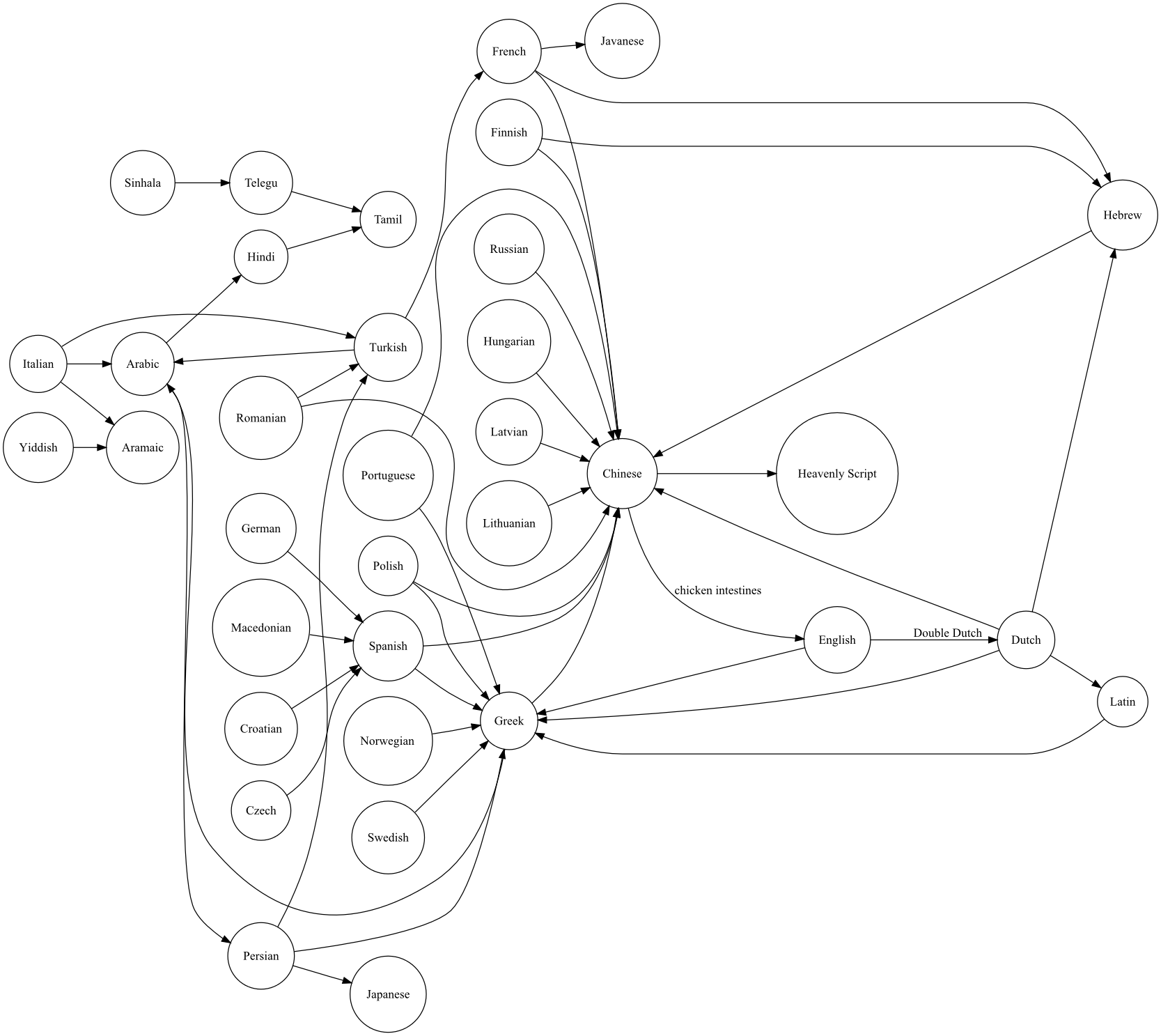
The Most Difficult Language on Earth

On Wikipedia there is a page on the expression "Greek to me", referring to an incomprehensible language to the speaker of another language. Language Log made a tree graph of these relative relationships. By far Chinese seems to be quite hard, isn't it. Thank est's blog for the pointer. Image.